

What Is Myopia?
Myopia, commonly called nearsightedness, is a vision condition in which nearby objects appear clear while distant objects appear blurry. It often develops because the eye is longer than average, causing incoming light to focus in front of the retina rather than directly on it.
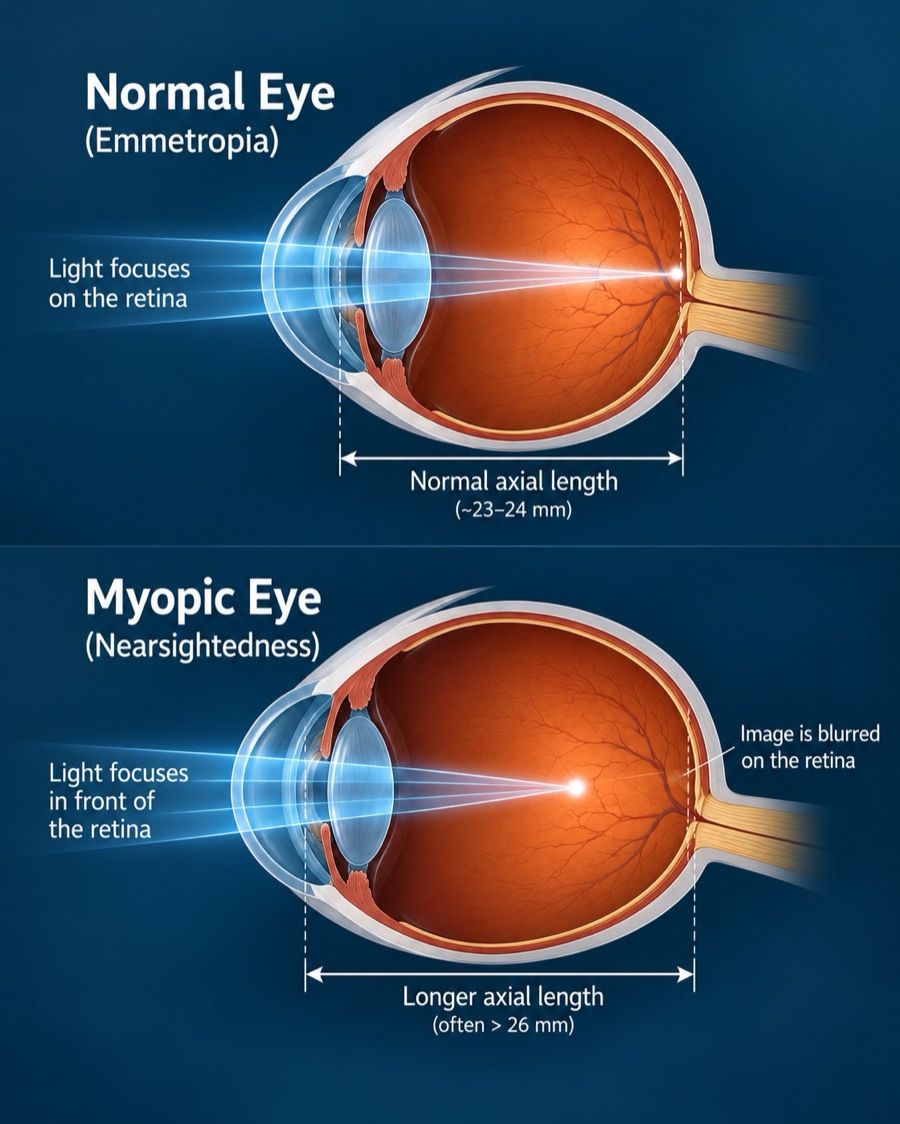
Myopia is increasingly common worldwide. Although most people think of nearsightedness as a problem corrected with glasses, contact lenses, or refractive surgery, it can also influence long-term eye health.
One important association is an increased risk of glaucoma.
How Does Myopia Increase Glaucoma Risk?
Glaucoma is a group of eye diseases that damage the optic nerve, the structure responsible for transmitting visual information from the eye to the brain. Without treatment, glaucoma can cause permanent vision loss.
Research consistently demonstrates an association between myopia and primary open-angle glaucoma, the most common form of glaucoma in the United States.
One explanation involves the elongated shape of myopic eyes. As an eye becomes longer, tissues surrounding the optic nerve may stretch and undergo structural changes.
These changes may include:
- Thinning or stretching of tissues surrounding the optic nerve.
- Tilting or enlargement of the optic nerve head.
- Changes in the structural support of the optic nerve.
- Potentially greater susceptibility to glaucoma-related optic nerve damage.
These mechanisms are still being studied. Importantly, glaucoma may develop even when eye pressure is within the statistically normal range.
How Much Does Myopia Increase Glaucoma Risk?
A 2022 systematic review and meta-analysis by Wu et al. examining the association between myopia and primary open-angle glaucoma found the following:
| Degree of myopia | Odds of glaucoma compared with nonmyopic eyes |
|---|---|
| Low myopia | 1.63 times |
| Moderate myopia | 2.27 times |
| High myopia | 3.47 times |
These estimates came from pooled observational studies. They describe relative odds, not an individual's probability of developing glaucoma, and the studies showed substantial variation.
Nevertheless, the findings suggest that higher degrees of nearsightedness are associated with greater glaucoma risk.
Why is Glaucoma More Difficult to Diagnose in Nearsighted Patients?
One of the challenges in managing glaucoma in highly myopic eyes is that nearsightedness itself can change the appearance of the optic nerve.
A myopic optic nerve may appear tilted, enlarged, or surrounded by areas of retinal thinning. These characteristics can sometimes resemble glaucomatous damage, even when glaucoma is absent.
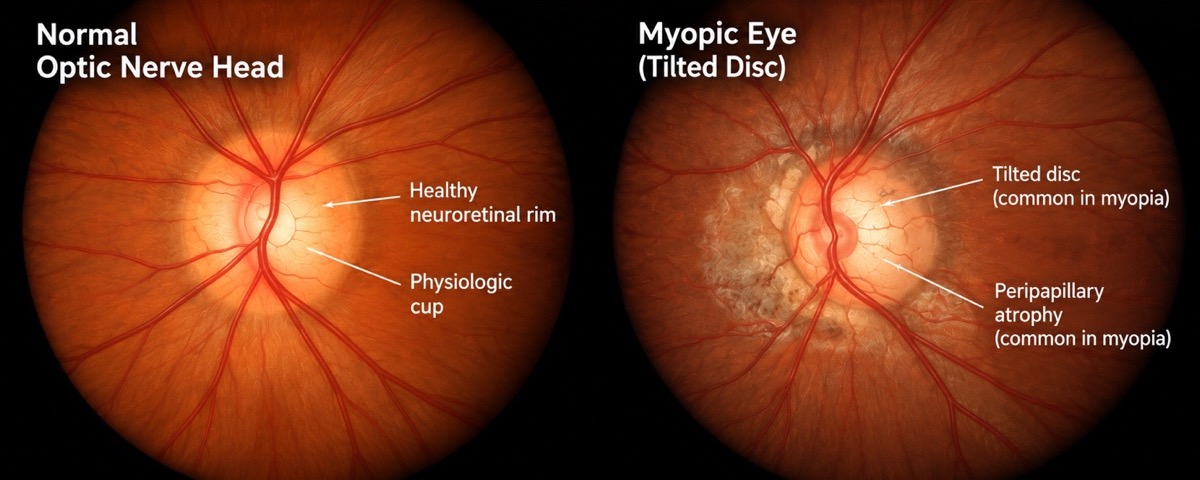
Likewise, optical coherence tomography (OCT), which measures the thickness of nerve tissue, may incorrectly flag certain regions as abnormal because highly myopic eyes differ from the reference population used by imaging devices.
For this reason, an abnormal OCT result does not automatically mean that a nearsighted patient has glaucoma.
A glaucoma specialist interprets these results alongside the appearance of the optic nerve, visual field testing, eye pressure, and changes over time.
What Tests Are Important for Nearsighted Patients?
A comprehensive glaucoma evaluation may include:
- Eye pressure measurement: Evaluates intraocular pressure, an important modifiable risk factor for glaucoma.
- Dilated optic nerve examination: Allows the ophthalmologist to evaluate the appearance of the optic nerve.
- Optical coherence tomography (OCT): Measures retinal nerve fiber layer and macular ganglion cell thickness.
- Visual field testing: Identifies areas of missing or reduced vision that may indicate optic nerve damage.
- Optic nerve photography: Provides a baseline for identifying structural changes during future examinations.
- Gonioscopy: Examines the drainage angle and helps classify the type of glaucoma.
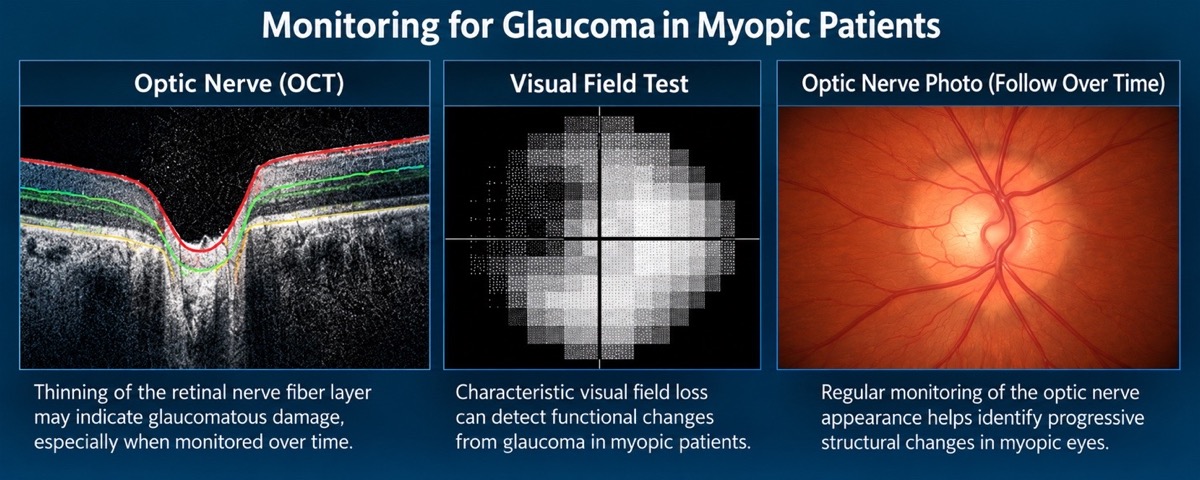
In highly myopic patients, comparing examinations over time can be particularly important because naturally occurring anatomical differences may complicate interpretation of a single test.
Can Glasses, Contact Lenses, or LASIK Reduce Glaucoma Risk?
Correcting nearsightedness does not necessarily remove the underlying anatomical characteristics associated with myopia.
Glasses and contact lenses improve how light focuses, but they do not shorten an elongated eye.
Similarly, LASIK changes the shape of the cornea to improve vision but does not eliminate the structural features of myopia that may be associated with glaucoma.
LASIK can also change how eye pressure measurements are interpreted, sometimes producing artificially lower readings with conventional methods.
Patients who have undergone refractive surgery should inform their ophthalmologist, particularly when being evaluated for glaucoma.
Should People With Myopia See a Glaucoma Specialist?
Not every nearsighted patient requires specialized glaucoma care. However, patients with high myopia, suspicious optic nerve findings, elevated eye pressure, a family history of glaucoma, or abnormal visual field testing may benefit from further evaluation.
Glaucoma often progresses without noticeable symptoms in its early stages. Patients may maintain excellent central vision while gradually losing peripheral vision.
Early detection provides an opportunity to intervene before significant vision loss develops.
Protecting One’s Vision
If one is highly nearsighted, regular comprehensive eye examinations are an important part of protecting your long-term vision.
At Inland Glaucoma Center, patients undergo individualized evaluations using optic nerve assessment and appropriate glaucoma testing. Understanding the differences between myopic anatomy and true glaucomatous damage is essential to avoiding both missed diagnoses and unnecessary treatment.
If you have high myopia or have been told that your optic nerves appear suspicious for glaucoma, consider scheduling a comprehensive glaucoma evaluation.
Works Cited
- Marcus MW, de Vries MM, Junoy Montolio FG, Jansonius NM. Myopia as a Risk Factor for Open-Angle Glaucoma: A Systematic Review and Meta-Analysis. Ophthalmology. 2011;118(10):1989-1994.e2. View study.
- The Association between Myopia and Primary Open-Angle Glaucoma: A Systematic Review and Meta-Analysis. Ophthalmic Research. 2022;65:387-397. PubMed.
- Evaluating Glaucoma in Myopic Eyes: Challenges and Opportunities. Survey of Ophthalmology. 2025;70(3):563-582. Read review.
- Interpreting the Structure-Function Relationship in High Myopia-Associated Glaucoma: A Review. Acta Ophthalmologica. 2026. Read review.
- American Academy of Ophthalmology. What Is Glaucoma? AAO patient education.