
By Robert Gunzenhauser, MD

If anyone has recently been diagnosed with glaucoma or ocular hypertension (higher-than-normal eye pressure), there's a good chance their ophthalmologist has mentioned latanoprost.
For millions of people around the world, latanoprost has become the first medication used to lower eye pressure and reduce the risk of vision loss from glaucoma. It's used just once each evening, is generally well tolerated, and has helped many patients delay, or even avoid, the need for additional medications or surgery.
But what exactly is latanoprost? How does it work? And what side effects should one know about before starting it?

A Brief History of Latanoprost
Before the 1990s, glaucoma treatment relied heavily on medications that either decreased the amount of fluid the eye produced or required multiple doses throughout the day.
Everything changed in 1996, when the U.S. Food and Drug Administration (FDA) approved latanoprost (brand name Xalatan). It was the first widely available medication in a class called prostaglandin analogs.
Its introduction represented a major advance in glaucoma care because it provided excellent pressure lowering, once-daily dosing, minimal effects on the rest of the body, and high rates of patient satisfaction and long-term use.
Today, prostaglandin analogs, including latanoprost, are considered the preferred first-line medication for many patients with open-angle glaucoma or ocular hypertension because of their effectiveness and convenience.
How Does Latanoprost Work?
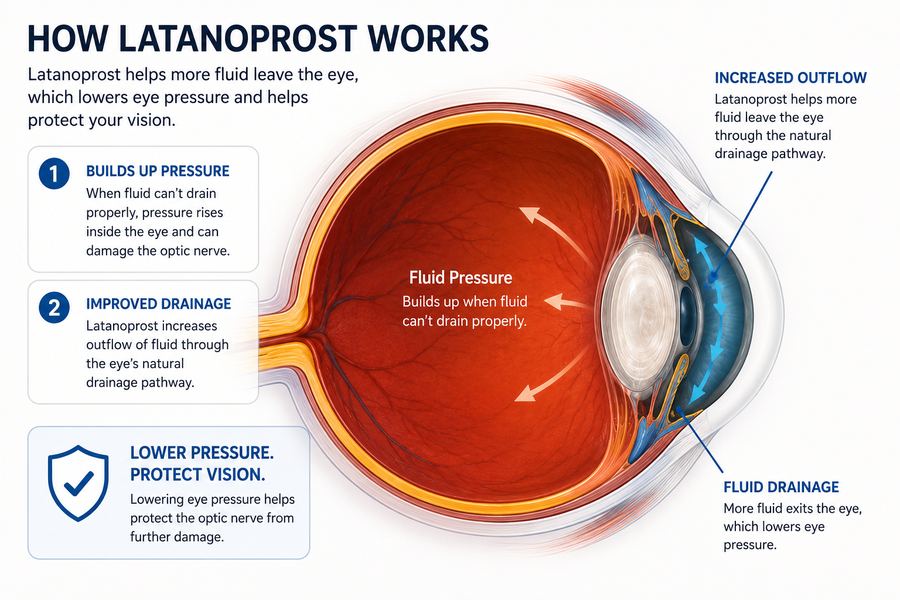
Inside every healthy eye, a clear fluid is constantly being produced and drained. Think of it like a sink with the faucet slowly running all day. If the drain doesn't work efficiently, fluid builds up and the pressure inside the eye rises. Over time, elevated pressure can damage the optic nerve, leading to glaucoma.
Latanoprost works by helping more fluid leave the eye naturally. Rather than turning off the "faucet," it improves one of the eye's natural drainage pathways. As more fluid exits the eye, the pressure inside the eye decreases.
Most patients begin seeing a pressure-lowering effect within several hours, with the greatest benefit occurring after about 8 to 12 hours. One drop each evening continues working for approximately 24 hours, which is why it only needs to be used once a day.
Why Is Lowering Eye Pressure So Important?
Currently, lowering eye pressure is the only treatment that has consistently been shown to slow or reduce the progression of glaucoma. While latanoprost cannot restore vision that has already been lost, lowering eye pressure helps protect the optic nerve from further damage. The goal isn't to improve eyesight immediately, it's to preserve the vision that a patient has for many years to come.
How Much Can Latanoprost Lower Eye Pressure?
Although every patient responds differently, clinical studies have shown that latanoprost typically lowers eye pressure by about 25% to 30% from baseline. For many people, that degree of pressure reduction is enough to reach their target pressure using just one medication. If additional pressure lowering is needed, their ophthalmologist may recommend adding another eye drop, laser treatment, or surgery.
Common Side Effects
Like any medication, latanoprost can cause side effects. Fortunately, most are mild and limited to the eye.
Mild eye redness: Some people notice mild redness when they first begin using the drops. This often improves after the first few weeks.
Eye irritation: Temporary burning, stinging, or a feeling that something is in the eye may occur immediately after placing the drop. These symptoms are usually brief.
Longer, thicker eyelashes: One of the most recognizable effects of latanoprost is that eyelashes may become longer, thicker, darker, and more numerous. Interestingly, this side effect led researchers to develop medications specifically for cosmetic eyelash growth. If one is treating only one eye, the difference in eyelash appearance may become noticeable over time.
Darkening of the iris: Latanoprost may gradually increase the amount of brown pigment in the colored part of the eye (the iris). This occurs most commonly in people whose eyes are naturally mixed colors, such as green-brown, hazel, or blue-brown. The color change usually develops slowly over months to years. Importantly: it does not damage the eye, it does not affect vision, it is generally considered a cosmetic change, and it is usually permanent even if the medication is stopped. Because of this, an ophthalmologist should discuss this possibility before one begins treatment, especially if only one eye requires the medication.
Darkening of the eyelid skin: Some patients notice the skin around the treated eye becoming slightly darker. Unlike iris color changes, this skin pigmentation often improves after the medication is discontinued.
Are Serious Side Effects Common?
Fortunately, serious side effects are uncommon. An ophthalmologist may use extra caution when prescribing latanoprost if one has certain eye conditions, such as a history of recurrent inflammation inside the eye or specific retinal diseases. These situations are relatively uncommon, which is why it's important for one's treatment plan to be individualized.
No one should stop a glaucoma medication without first speaking with their ophthalmologist, as doing so could allow eye pressure to rise and place the optic nerve at risk of permanent damage.
Is Latanoprost Right for Everyone?
Not necessarily. Every patient has different eyes, different medical conditions, and different treatment goals. For many people, latanoprost is an excellent first choice because it is effective, convenient, and generally well tolerated. Others may benefit from a different medication, laser treatment, or surgery depending on their specific situation. The best treatment is the one that's tailored to the individual patient.
If a patient's ophthalmologist recommends latanoprost, that patient should not hesitate to ask questions about how it works, what side effects to expect, and how it fits into their overall glaucoma care plan.
References
- Patel SS, Spencer CM. Latanoprost: A Review of Its Pharmacological Properties and Clinical Potential in Open-Angle Glaucoma and Ocular Hypertension. Drugs. 1996;52(6):883-904. Alm A. Latanoprost in the Treatment of Glaucoma. Clinical Ophthalmology. 2014;8:1967-1985. Digiuni M, Manni G, et al. A Review of the Use of Latanoprost for Glaucoma Since Its Launch. Expert Opinion on Pharmacotherapy. 2012. Tripathy K. Latanoprost. StatPearls Publishing. Updated 2024. Zhou L, et al. Clinical Pharmacology and Pharmacogenetics of Prostaglandin Analogues in Glaucoma. Frontiers in Pharmacology. 2022.