
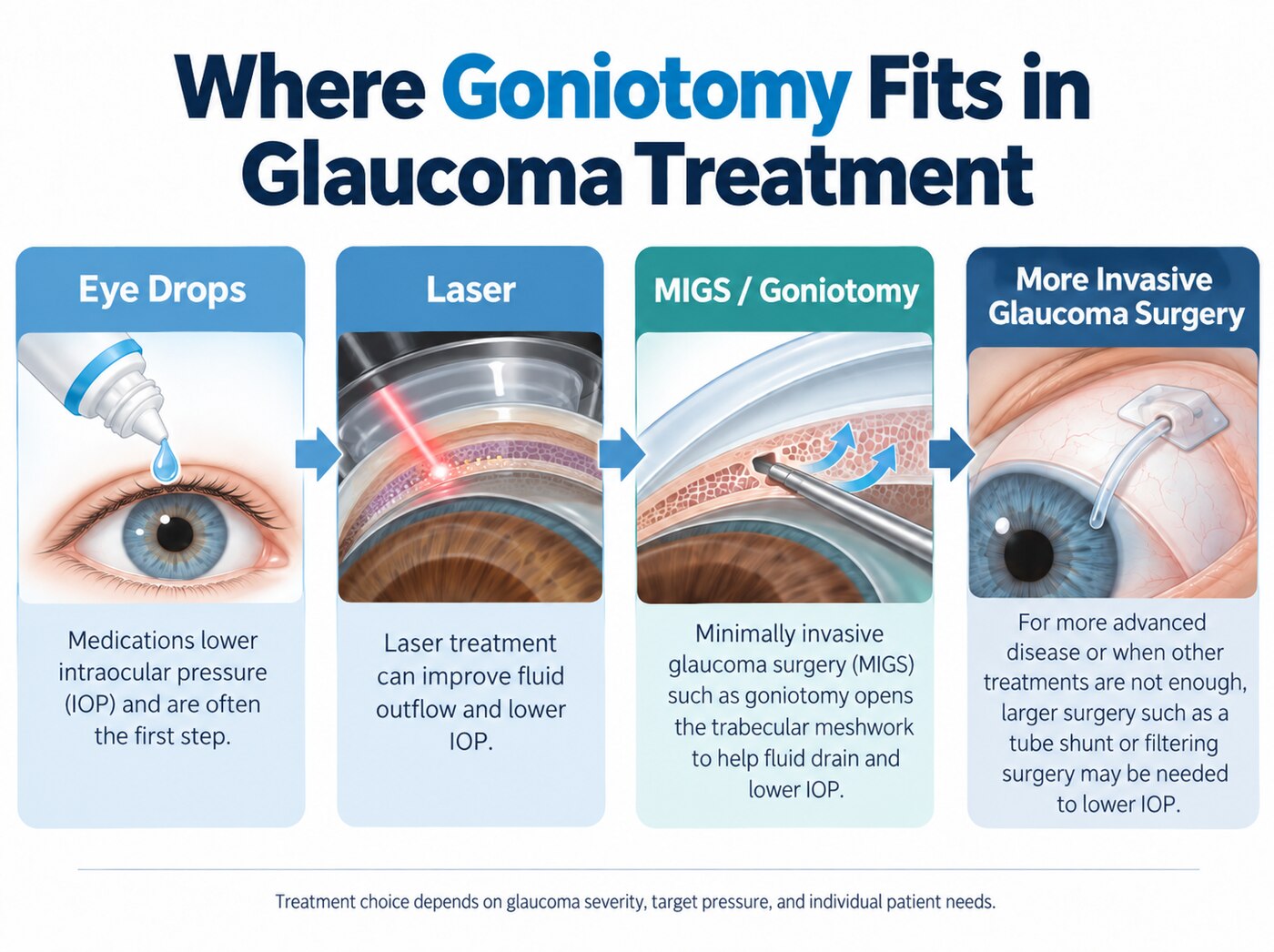
Glaucoma is commonly treated with eye drops or laser procedures, but some patients may also benefit from surgery to help lower the pressure inside the eye.
One increasingly common option is goniotomy, a procedure that works directly on the eye’s natural drainage system. Although goniotomy has existed for many decades, modern surgical techniques have allowed it to become an important part of minimally invasive glaucoma surgery, often referred to as MIGS.
For appropriately selected patients, goniotomy may lower eye pressure, reduce the number of glaucoma medications needed, or accomplish both. However, the degree of pressure reduction varies, and goniotomy is not appropriate for every form or stage of glaucoma.
How Does the Eye Normally Drain Fluid?
The front of the eye continuously produces a clear fluid called aqueous humor. This fluid circulates through the eye and then exits primarily through a drainage structure called the trabecular meshwork, located where the iris and cornea meet.
A useful comparison is a sink with a continuously running faucet and a drain.
In many forms of open-angle glaucoma, resistance develops within the eye’s drainage system. Fluid does not leave the eye as easily as it should, which can contribute to elevated intraocular pressure, or IOP.
Over time, excessive eye pressure can damage the optic nerve. Because glaucoma-related optic nerve damage is generally permanent, treatment focuses on lowering eye pressure to reduce the risk of additional damage.
What Is a Goniotomy?
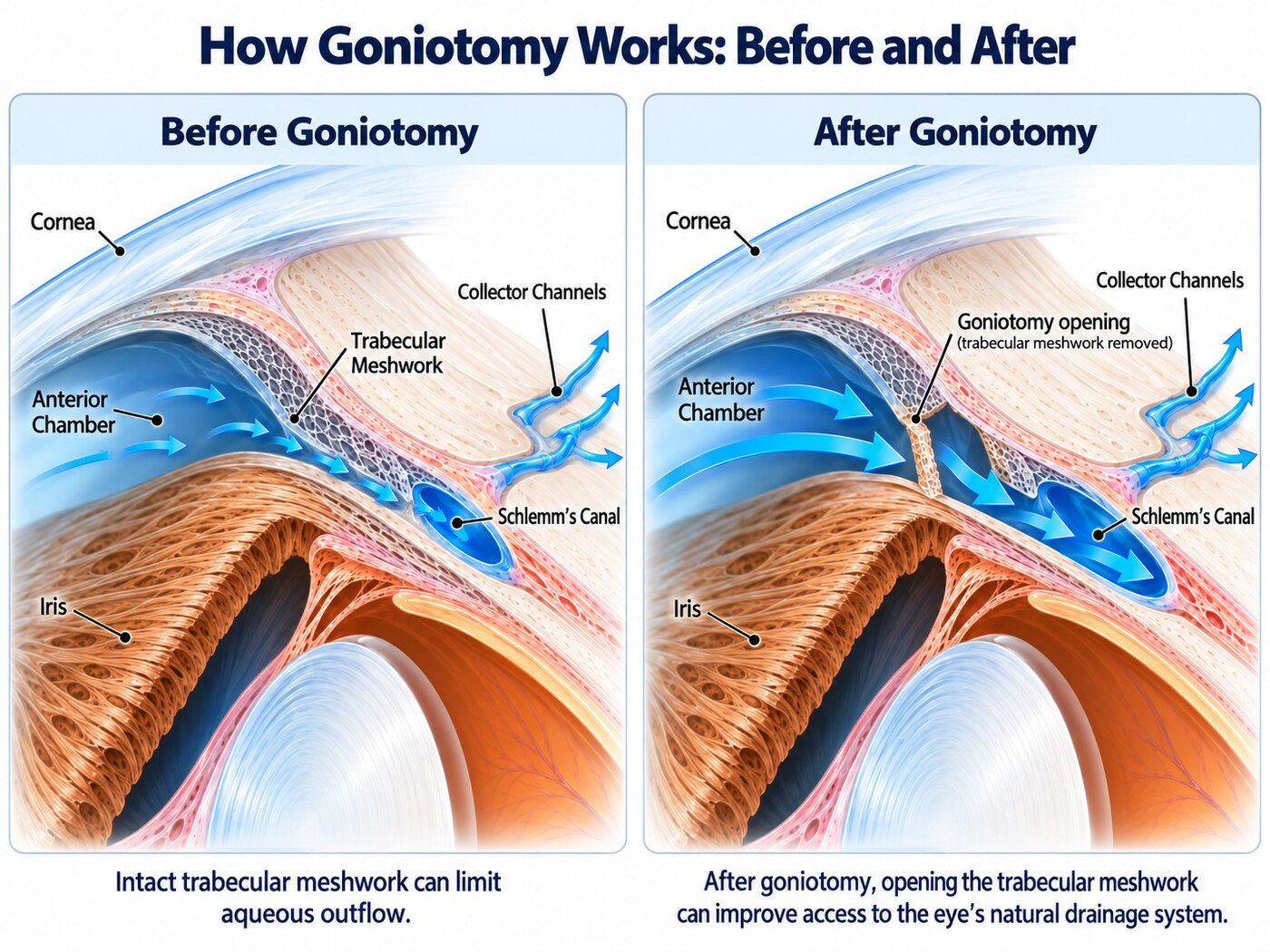
Goniotomy is an internal glaucoma surgery that opens or removes a portion of the trabecular meshwork.
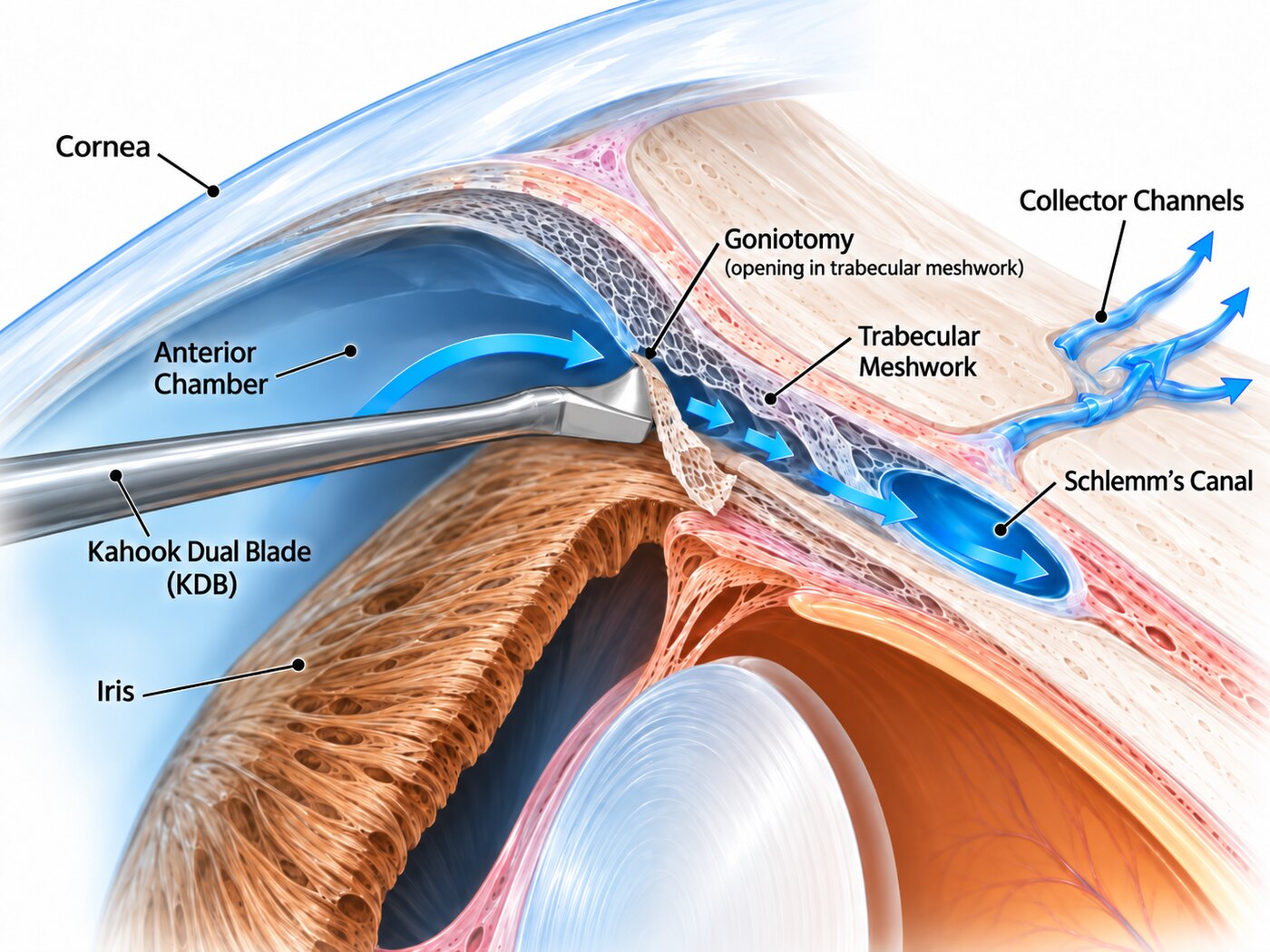
During the procedure, a surgeon enters the eye through a small corneal incision and uses a special lens to directly see the eye’s drainage angle. A small surgical instrument is then used to cut or remove a section of trabecular meshwork.
This creates a more direct pathway for aqueous fluid to reach Schlemm’s canal, an important part of the eye’s natural drainage system.
Unlike traditional filtering operations such as trabeculectomy or glaucoma drainage implants, goniotomy generally does not create a new drainage pathway outside the eye. Instead, it attempts to improve access to the drainage system that is already present.
For this reason, modern goniotomy is often grouped with angle-based minimally invasive glaucoma surgery.
Goniotomy Is Actually an Old Operation
Although modern instruments have made goniotomy increasingly common in adult glaucoma surgery, the basic concept is not new.
An early operation involving incision of the drainage angle was described by Italian ophthalmologist Carlo de Vincentiis in the late 1800s. The procedure was later refined and popularized by ophthalmologist Otto Barkan in the 1930s, particularly for the treatment of congenital glaucoma in children.
For many years, goniotomy was therefore thought of primarily as an operation for childhood glaucoma.
Modern microsurgical instruments later allowed surgeons to revisit the same basic idea for adults with glaucoma. Rather than simply making an incision in the trabecular meshwork, some contemporary techniques remove a narrow strip of this tissue.
This modern form is sometimes called excisional goniotomy.
Several surgical instruments can be used to perform goniotomy. The underlying goal is similar: reduce resistance at the trabecular meshwork and allow aqueous fluid easier access to the eye’s natural drainage channels.
When Is Goniotomy Used?
Goniotomy is most commonly considered for patients with open-angle forms of glaucoma in whom the natural drainage angle can be adequately visualized and accessed.
It may be performed:
- by itself as a glaucoma procedure, or
- at the same time as cataract surgery.
The procedure may be considered when the goal is to lower eye pressure, decrease dependence on glaucoma medications, or both.
However, glaucoma treatment is highly individualized. A target pressure suitable for someone with mild glaucoma may be very different from the pressure required for someone with advanced optic nerve damage.
Goniotomy also generally does not produce the extremely low pressures that can sometimes be achieved with more extensive operations such as trabeculectomy or glaucoma drainage implants. For some patients with advanced or difficult-to-control glaucoma, a different operation may therefore be more appropriate.
How Effective Is Goniotomy?
Published studies generally show that modern goniotomy can produce meaningful reductions in both eye pressure and glaucoma medication use, although results vary depending on the population studied.
A review of studies involving excisional goniotomy reported average IOP reductions of approximately 11–36% when goniotomy was performed alone and approximately 11–34% when performed with cataract surgery. Medication reductions also varied across studies.
One prospective multicenter study followed 52 eyes with medically treated open-angle glaucoma after cataract surgery combined with goniotomy. Average pressure decreased from 16.8 mmHg before surgery to 12.4 mmHg at 12 months, a reduction of approximately 26%. Average glaucoma medication use decreased from 1.6 medications to 0.8 medications.
These numbers provide useful estimates, but they should not be interpreted as a guarantee of a particular result for an individual patient.
An Important Limitation of the Data
Glaucoma surgical studies can be difficult to compare directly.
Some studies include patients with relatively mild glaucoma, while others include advanced disease. Baseline pressures may also differ substantially. A patient beginning with an IOP of 25 mmHg has more opportunity for a large percentage reduction than a patient whose pressure is already 15 mmHg on several medications.
Additionally, many studies evaluate goniotomy performed at the same time as cataract surgery. Cataract surgery itself can modestly lower eye pressure, making it difficult in some studies to determine exactly how much of the pressure reduction resulted from the goniotomy.
Much of the published goniotomy literature also consists of prospective or retrospective case series rather than large randomized controlled trials. These limitations are important when interpreting reported success rates.
More recent comparative research continues to evaluate goniotomy against other MIGS procedures. A 2025 systematic review and meta-analysis included 14 studies and 1,959 eyes comparing cataract surgery with Kahook Dual Blade goniotomy against cataract surgery with trabecular micro-bypass stents. Both approaches reduced IOP and medication requirements, with differences depending on the particular stent and follow-up interval.
The Key Takeaway
Goniotomy improves access to the eye’s natural drainage system by opening or removing part of the trabecular meshwork.
Although the operation has roots going back more than a century and was historically used primarily for childhood glaucoma, modern surgical instruments have transformed goniotomy into an important minimally invasive option for selected adults with glaucoma.
Clinical studies suggest that modern goniotomy can lower eye pressure and may decrease the need for glaucoma medications. The magnitude of that benefit varies considerably between patients, however, and some forms or stages of glaucoma require other surgical approaches.
The choice of glaucoma treatment depends on the type and severity of glaucoma, existing optic nerve damage, current eye pressure, medication use, anatomy of the eye, and the pressure required to reduce the risk of further vision loss.
This article is intended for general educational purposes only and does not provide individual medical advice. Decisions regarding glaucoma treatment and surgery should be made after examination and discussion with a qualified ophthalmologist familiar with a patient’s specific medical and ocular circumstances.
References
- Mandal AK, Chakrabarti D. Update on congenital glaucoma. Indian Journal of Ophthalmology. 2011;59(Suppl 1):S148-S157. Historical review discussing the early development of goniotomy.
- Dorairaj SK, Seibold LK, Radcliffe NM, et al. 12-Month Outcomes of Goniotomy Performed Using the Kahook Dual Blade Combined with Cataract Surgery in Eyes with Medically Treated Glaucoma. Advances in Therapy. 2018;35:1460-1469. Provides 12-month efficacy data for combined cataract surgery and goniotomy.
- Dorairaj S, Radcliffe NM, Grover DS, et al. A Review of Excisional Goniotomy Performed with the Kahook Dual Blade for Glaucoma Management. Journal of Current Glaucoma Practice. 2022;16(1):59-64. Summarizes outcomes across multiple studies of excisional goniotomy.
- Guedes J, Amaral DC, Caneca KO, et al. Kahook Dual Blade Goniotomy Versus iStent Implantation Combined With Phacoemulsification: A Systematic Review and Meta-Analysis. Journal of Glaucoma. 2025. Comparative review of goniotomy versus trabecular micro-bypass approaches combined with cataract surgery.