
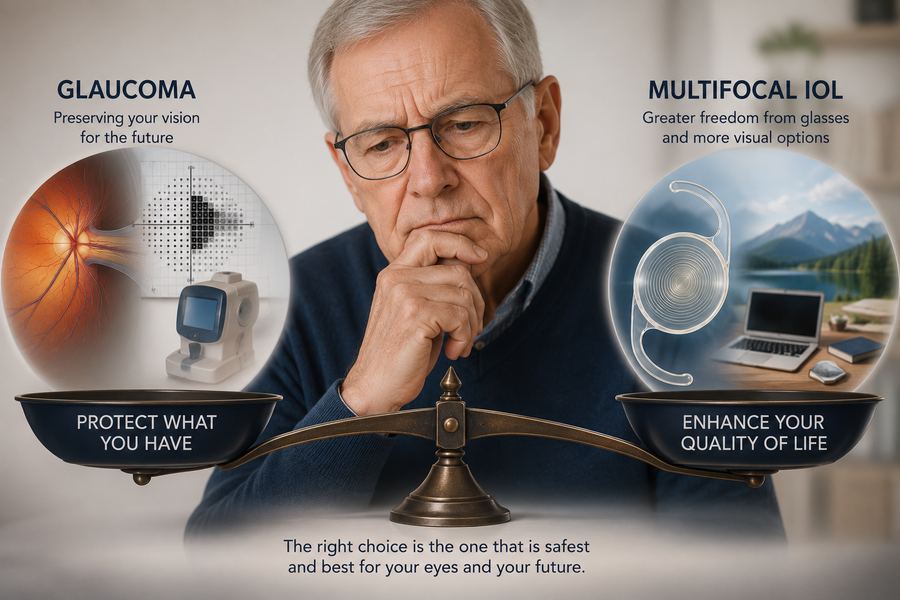
If you have glaucoma and are planning cataract surgery, one of the biggest decisions you'll make is choosing your intraocular lens (IOL).
Many patients ask us: "Can I still get a premium lens if I have glaucoma?" The answer is sometimes, but not every premium lens is the right choice for every stage of glaucoma.
Modern cataract surgery offers remarkable technology that can reduce dependence on glasses. However, glaucoma affects the optic nerve and often decreases contrast sensitivity and peripheral vision, sometimes long before a patient notices changes on the eye chart.
Because several premium lens designs also reduce contrast sensitivity, choosing the right lens requires balancing the desire for spectacle independence with the need to preserve the highest possible quality of vision.
At our practice, we believe that the best lens is not necessarily the one that offers the greatest freedom from glasses, but the one that provides the safest, clearest vision for your individual eyes.
Understanding Premium Lens Options
Not all "premium" intraocular lenses are the same. Some premium lenses are designed primarily to correct astigmatism (toric lenses), while others aim to reduce dependence on glasses by extending the range of vision after cataract surgery.
Enhanced monofocal lenses provide a modest improvement in intermediate vision while maintaining image quality that closely resembles a traditional monofocal lens. For many glaucoma patients, these lenses offer an excellent balance between visual function and preservation of contrast sensitivity.
Extended depth of focus (EDOF) lenses are designed to increase the range of vision with fewer visual side effects than traditional multifocal lenses. While some of the newest EDOF designs appear promising, experience in patients with glaucoma, particularly moderate and advanced glaucoma, is still evolving.
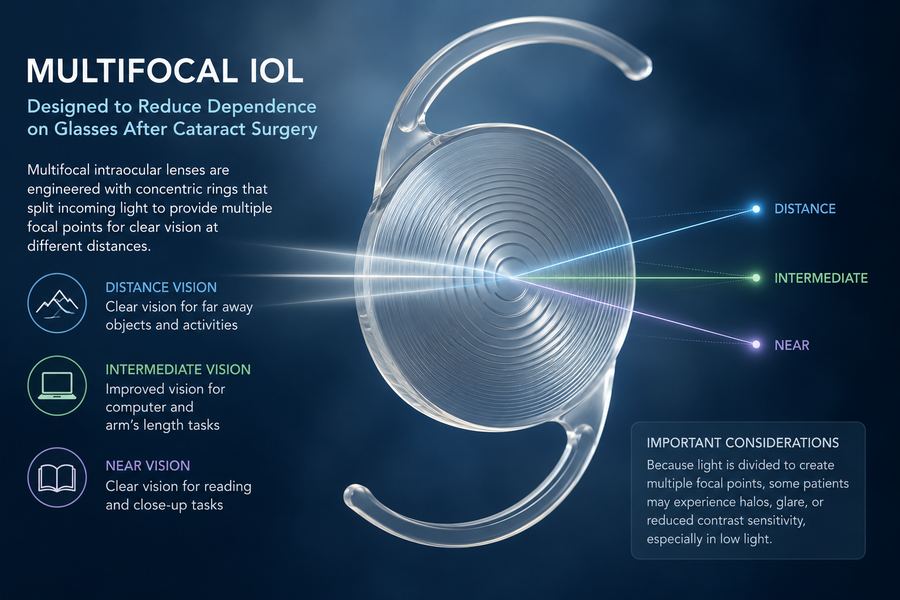
Multifocal and trifocal lenses split incoming light into multiple focal points to provide distance, intermediate, and near vision. Although these lenses can significantly reduce the need for glasses, they also reduce contrast sensitivity and may increase glare and halos. Because glaucoma itself can impair contrast sensitivity, these lenses are generally not recommended for patients with established visual field loss.
Rather than asking which lens is "best," we believe the better question is: which lens provides the safest balance between visual quality and spectacle independence for your particular eyes?
Why Contrast Sensitivity Matters
Most patients think vision is measured by the eye chart. In reality, contrast sensitivity, the ability to distinguish subtle differences between shades of gray, is equally important for everyday visual function. Contrast sensitivity affects many common daily activities, including driving at night, reading in dim lighting, seeing curbs and steps, recognizing faces, and walking safely in low-light environments.
Glaucoma commonly reduces contrast sensitivity, even in patients who still read 20/20 on the eye chart. Traditional multifocal lenses also reduce contrast sensitivity because they divide incoming light into multiple focal points. When these two effects are combined, patients may experience vision that is technically sharp but feels less crisp or less comfortable, particularly at night or in dim lighting. This is the primary reason glaucoma specialists have historically been cautious about multifocal lenses.
Mild Glaucoma: Premium Lenses May Still Be Appropriate
Patients with mild, well-controlled glaucoma often remain reasonable candidates for certain premium lens technologies. These patients typically have stable intraocular pressure, minimal visual field loss, good central vision, healthy contrast sensitivity, and stable disease over time.
Toric monofocal lenses and enhanced monofocal lenses are excellent options for many patients with mild glaucoma. Selected enhanced monofocal lenses and, in carefully chosen circumstances, certain non-diffractive EDOF lenses may also be reasonable options for patients who understand the potential benefits and future limitations if their glaucoma worsens.
Although some surgeons may still offer multifocal lenses to highly selected patients with very mild glaucoma, this should only occur after a thorough discussion regarding the potential tradeoff between spectacle independence and potential for future reduced contrast sensitivity. Careful patient selection and realistic expectations are essential.
Moderate Glaucoma: A More Conservative Approach
Patients with moderate glaucoma deserve particularly careful consideration. By this stage, measurable visual field loss is present, and many patients have already experienced some degree of reduced contrast sensitivity, even if they have not noticed significant symptoms. In addition, glaucoma is a lifelong disease, and even if vision is currently stable, future progression cannot always be predicted.
For these reasons, we generally become significantly more conservative when recommending premium lenses. For most patients with moderate glaucoma, enhanced monofocal lenses may represent the premium technology that is most consistently supported by current evidence and expert opinion. Enhanced monofocal lenses provide a modest increase in intermediate vision while maintaining image quality that closely resembles a traditional monofocal lens.
By contrast, we generally do not recommend traditional multifocal lenses in patients with moderate glaucoma because any additional reduction in contrast sensitivity may have meaningful functional consequences. Likewise, although newer non-diffractive EDOF lenses may preserve contrast better than traditional multifocal lenses, long-term published experience in patients with moderate glaucoma remains limited.
Our guiding principle is simple: when glaucoma is already affecting vision, preserving image quality is more important than maximizing spectacle independence.
Advanced Glaucoma: Preserving Vision Comes First
For patients with advanced glaucoma, the priorities become much clearer. These patients often have significant visual field loss, reduced contrast sensitivity, difficulty with night driving, and challenges seeing in dim lighting. Because glaucoma has already permanently reduced the eye's visual reserve, maintaining the highest possible image quality becomes our primary goal.
For this reason, we generally do not recommend traditional multifocal or trifocal lenses for patients with moderate-to-severe visual field loss. Instead, we typically recommend standard monofocal lenses, toric monofocal lenses (when astigmatism is present), and enhanced monofocal lenses in appropriate situations.
Although these options may require reading glasses after surgery, they maximize contrast sensitivity and provide the clearest possible image. For patients who have already lost vision from glaucoma, preserving the quality of the remaining vision is almost always the better long-term decision.
What About the Newer EDOF Lenses?
Lens technology continues to evolve rapidly. Several newer non-diffractive and refractive EDOF lenses have been designed to extend the range of vision while minimizing the reduction in contrast sensitivity seen with traditional multifocal lenses. One example is the TECNIS PureSee, which has shown promising early results by providing improved intermediate vision with visual quality that more closely resembles a monofocal lens.
These early studies are encouraging. However, it is important to recognize that the published experience in glaucoma patients, particularly those with moderate or advanced disease, remains relatively limited. Much of the available data involve healthy eyes or patients with only mild, stable glaucoma. Several next-generation lens designs are currently in clinical development and may further improve the balance between extended range of vision and preservation of contrast sensitivity.
For now, we believe that careful patient selection should remain the cornerstone of premium lens decisions, and we continue to prioritize preserving visual quality over reducing dependence on glasses.
Our Philosophy
There is no "one-size-fits-all" answer when selecting an intraocular lens for a patient with glaucoma. Instead, we consider the severity and stability of your glaucoma, visual field testing, OCT imaging, contrast sensitivity, your lifestyle, your visual goals, and the likelihood of future glaucoma progression.
For patients with mild glaucoma, several premium lens options may be appropriate. For patients with moderate glaucoma, we generally recommend discussing options on a case-by-case basis with your provider, certain types of more premium lenses such as an enhanced monofocal may be a suitable option that best balances visual quality and functional vision. For patients with advanced glaucoma or significant visual field loss, our priority shifts toward maximizing contrast sensitivity and preserving every bit of remaining vision, making monofocal-based lens choices the safest recommendation.
Ultimately, our goal is not simply to reduce your dependence on glasses, it is to help you enjoy the best possible vision for many years to come.
Schedule a Consultation
If you have glaucoma and are considering cataract surgery, choosing the right intraocular lens is one of the most important decisions you'll make. Our surgeons carefully evaluate your glaucoma, lifestyle, and visual goals to recommend the lens technology that provides the safest and best possible long-term outcome for your eyes.
References
- Hong ASY, Chawla A, Chang RT, et al. Premium Intraocular Lenses in Glaucoma, A Systematic Review. Bioengineering. 2023;10(9):993. Chen PP, et al. IOL Selection for Glaucoma Patients. Glaucoma Today. 2019. Kerr NM. IOL Selection in Patients with Glaucoma. Clinical & Refractive Ophthalmology. 2022. Cho JY, et al. Comparative Outcomes of Accommodative, Multifocal, Extended Depth-of-Focus, and Monofocal Intraocular Lenses: A Systematic Review and Bayesian Network Meta-analysis. JAMA Ophthalmology. 2022;140(10):1045-1053. Park ESY, et al. Comparative Outcomes of the Next-Generation Extended Depth of Focus Intraocular Lens and an Enhanced Monofocal Lens. 2025. Urcola JA, et al. Evaluation of Visual, Refractive, and Functional Outcomes Following Implantation of an Extended Depth-of-Focus Intraocular Lens in Patients with Mild Glaucoma. 2025. American Academy of Ophthalmology. EyeNet Magazine. Cataract Surgery in Eyes with Glaucoma. American Glaucoma Society. Educational resources on cataract surgery and intraocular lens selection in glaucoma patients.
- This article is intended for educational purposes only and should not replace an individualized discussion with your ophthalmologist regarding the most appropriate intraocular lens for your eyes.